Monday, August 11, 2008

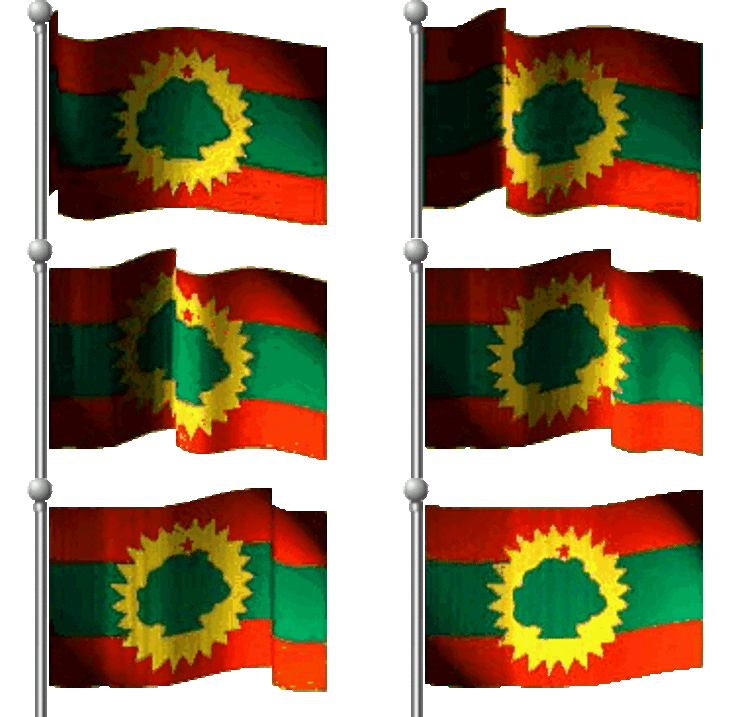
The Asmara Group schism should not divide the Oromo people. OLF


ADDA BILISUMMAA OROMOO
OROMO LIBERATION FRONT

Guyyaa (Date): Hagaya 08, 2008


The Asmara Group schism should not divide the Oromo people


The Asmara Group, which is dishonestly continuing to call itself the Oromo Liberation Front (OLF), has been split into two albeit to advance the programmes of the enemies of the Oromo struggle. Both factions of the Asmara Group openly pledge allegiance to Ethiopia rather than Oromia. Their allegiance to Ethiopia has been further symbolized by their repeated waving of the Ethiopian flag at meetings and public rallies in London, Washington DC and elsewhere. The OLF stands for independent Oromia not Ethiopia. Thus, we would like to reiterate once again that the factions of the Asmara Group cannot call themselves the OLF.


What is more, we are concerned that the two factions of the Asmara Group are engaged in shameless acts of wilfully and knowingly dividing the Oromo people along regional lines to garner support for their own sinister hidden motive. The hidden motive of these factions of the Asmara Group is to weaken the unity of the Oromo people in order to promote their anti-Oromo agenda in collaboration with Abyssinians.


We have been warning against the dangers that the aforementioned groups pose to the unity of the Oromo nation and the Oromo struggle for freedom for nearly a decade. Their illegal alteration of the OLF political programme and their unashamed collaboration with anti-Oromo Naftanya political organizations such as the Ethiopian Coalition for Unity and Democracy Party (CUD), Ethiopian People's Patriotic Front (EPPF) and Ginbot 7 bear testimony to our concerns. The formation of Alliance for Freedom and Democracy (AFD) with the CUD is also another example of the anti-Oromo activities committed by the Asmara Group.


Now, the same group is busy setting Oromo against Oromo. It was the same group that set members of the Oromo Liberation Army (OLA) against each other and caused unwarranted blood shed in the Southern Command in the summer of 2002. They are also spending tens of thousands of dollars collected from the Oromo public on the ongoing expensive unnecessary legal battle they instigated in their bid to destroy the OLF.


Our message to supporters of the two factions of the Asmara Group is that both factions have already divided the OLF since 2001 and now willing to divide the Oromo diaspora communities along regional lines. Evidence is also emerging that some elements of the Asmara Group have started to spread suspicion and bad feelings among Oromos back home in Oromia. Such vicious act must be nipped in the bud. We must learn the lesson from our neighbours in Somalia how disastrous it is to organize oneself along regional and clan lines rather than political objectives. Time has come for you to bring to an end this divisive project that you have tolerated for far too long.


The OLF struggles to liberate Oromia. We are organized under the guiding principle of the ideology of Oromummaa and political objective of independent Oromia. To this end, the OLF is working closely with other Oromo political organizations within the framework of the United Liberation Forces of Oromia (ULFO), and Oromo civic societies to strengthen the unity of our nation.


The only possible rational conclusion that can be drawn from the actions of the Asmara Group is that they are created and sponsored by anti-Oromo forces. Therefore, any Oromo worthy of the name should not co-operate with any group that works contrary to the just cause of the Oromo people and against the struggle to liberate our country.


We call upon true Oromo nationalists still supporting the Asmara Group to abandon both of the aforementioned factions and join us not only to continue with the struggle to save our people from genocide that is being perpetrated by the Ethiopian state against the Oromo nation but also to prevent the looming civil war that is being engineered by factions of the Asmara Group.


The irresponsible actions of the aforementioned two factions of the Asmara Group are threatening the integrity of our society and unity of our nation. The strong unity of the Oromo people has been affirmed by the bloods and bones of our fallen heroes and heroines in the mountains of Oromia over the past four decades and it should not be eroded by opportunists and reactionary forces. To this end, we would like to call upon the Oromo diaspora to curtail their assistance, be it in the name of region or otherwise, to both factions of the Asmara Group as a matter of urgency.


We urge the Oromo people to be vigilant and safeguard their unity and the gains of our struggle by standing with the genuine OLF under our leadership.


We would like to reassure the Oromo public and our true supporters that the Oromo struggle under the leadership of our organization will continue until we realise our final goal of liberating our country from century old Abyssinian colonization.
Oromia shall be free!

Dhugaasaa Bakakkoo Chairman
Oromo Liberation Front


Wednesday, July 30, 2008

Waamicha Walgahii Addi Blisummaa Oromoo Hawaasa Oromoo Maraaf godhe

Waamicha Walgahii Haawaasaa Oromoo Maraaf


Akeeka:


Haala ABOn keessa jiru odeeffannoo waliif dabarsuu;
Rakkinoota QBO qancarsan wal-hubachiisuu fi waliin xiinxaluun furmaata itti soquu; fi kkf;


Yoom? Jimaata, Hagayya/August 1, 2008, Saa 1:00 - 5:00 WB


Eessatti?


Music Hall -Sateren Auditorium Augsburg College2211 Riverside AveMinneapolis, MN 55454, United States


Beeksisa:


J/Galaasaa Dilboo, xurree quunnamtii ammayyaatti (vidio conference) hirmaatu.


Walgahii kana irratti gumaacha maallaqaa osoo hin tahin gumaacha yaadaa barbaanna.
Konkolaataa "parking lot" Augsburg keessa tola dhaabuu dandeessu.


Oromiyaan Ni Bilisoomt!!

Friday, July 11, 2008

Aid Group Pulls Out of Eastern Ethiopia, Charging Government Harassment


Source: VOA News

By Peter Heinlein Addis Ababa

The Swiss section of the aid group Doctors Without Borders (MSF) is halting humanitarian operations in a conflict-wracked region of eastern Ethiopia, charging government harassment and intimidation. VOA's Peter Heinlein has details from the Ethiopian capital, Addis Ababa.

The Swiss section of Doctors Without Borders says it decided to withdraw from Ethiopia's Fiiq region in the face of repeated administrative hurdles and intimidations, including the detention of humanitarian staff. Fiiq is in the eastern Somali region, where Ethiopian troops are waging a fierce counterinsurgency campaign against rebels of the Ogaden National Liberation Front (ONLF).

A statement sent to reporters Thursday says medical teams dispatched to the region in December of last year were prevented from providing urgently needed care to vulnerable populations.

Doctors Without Borders spokesman in Addis Ababa Stefan Reynier told VOA that over the past six months, aid workers could only work for 10 weeks in the town of Fiiq, and only five weeks in outlying areas, where conditions are more severe. He says government officials repeatedly harassed and intimidated aid workers.

"In January and February, we tried to develop an evaluation. And the team was arrested with no reason for three weeks in spite [of the fact that] they had all authorization," he recalled. "Later, in March and April, we were ordered to withdraw all our team for immigration issues. We tried to engage in dialogue and find a compromise, in order to have the right stature and to develop an operation. It has not been possible so far, and we don't see in the near future a possibility to find a compromise. And in June, up to this week, we had five employees arrested for three weeks for no reason and no official information."

A senior Ethiopian government official told VOA he was aware of the aid group pullout, but had no other immediate comment.

Doctors Without Borders' Reynier says an assessment conducted early this year showed nine percent of the children in Fiiq had symptoms of severe malnutrition. He says people in the region are struggling to cope with years of drought, aggravated by the government's harsh counterinsurgency tactics.

"We believe, in this area, it's not possible to develop independent, impartial and neutral humanitarian action," he added. "And, in those conditions, we cannot operate, and we cannot respond to the immediate needs of people, and this is the problem MSF [Doctors Without Borders] Switzerland is facing, because we cannot operate, because we cannot have an impact on the situation, we have decided to close and to make it public."

Ethiopian government officials have in the past denied allegations of restricted access in the Ogaden. Other sections of Doctors Without Borders from Holland, Belgium and Greece are still operating there. The Swiss section has been providing medical help in other parts of Ethiopia since 1993.

But last year, the government expelled the International Committee of the Red Cross (ICRC) after 12 years of humanitarian and relief work in the Ogaden. The regional president accused ICRC workers of collaborating with the rebels, a claim Red Cross representatives strongly denied.

Humanitarian agencies and Ethiopian officials both say aid deliveries are often disrupted by clashes between government troops and ONLF fighters.

The ethnic Somali rebels have been fighting for greater autonomy or independence since Ethiopia seized the Ogaden in a war with Somalia 30 years ago. Tensions escalated in early 2007 after the rebels attacked a Chinese-run oil exploration facility, killing 65 Ethiopians and several Chinese nationals.

Thursday, July 03, 2008

Government Prepares Assault on Civil Society; Human Rights Watch and Amnesty International said

Repressive New Legislation Should Be Amended or Scrapped


(New York, July 1, 2008) – Ethiopia’s government should immediately abandon plans to impose strict government controls and draconian criminal penalties on nongovernmental organizations (NGOs), Human Rights Watch and Amnesty International said today. The two groups called on donor governments, whose behind-the-scenes efforts to see the bill reformed appear to have failed, to speak out publicly against the de facto criminalization of most of the human rights, rule of law and peace-building work currently being carried out in Ethiopia.

Ethiopia’s federal government claims that its draft Charities and Societies Proclamation (draft law) is a benign attempt to promote financial transparency among NGOs and enhance their accountability to stakeholders. In fact, the law’s key provisions are blunt and heavy-handed mechanisms to control and monitor civil society groups while punishing those whose work displeases the government. It could also seriously restrict much of the development-related work currently being carried out by some of Ethiopia’s key international partners, Human Rights Watch and Amnesty International said.

“Ethiopia’s government has already made meaningful public engagement in governance impossible in many areas by persecuting its critics and cracking down on freedom of expression and assembly,” said Georgette Gagnon, Africa director at Human Rights Watch. “The clear intention of this legislation is to consolidate that trend by taking the ‘non’ out of ‘nongovernmental’ and putting civil society under government control.”

The law would apply to every NGO operating in Ethiopia except religious organizations and those foreign NGOs that the government agrees to exempt. Many of the key provisions of the draft law would violate Ethiopia’s obligations under international human rights law and fundamental rights guaranteed in its own constitution, including the right to freedom of association and freedom of expression. Human Rights Watch and Amnesty International have both produced separate detailed analyses of the draft law (analysis by Human Rights Watch and byAmnesty International). Among its most damaging provisions are articles that would:
Impose stiff criminal penalties for anyone participating in “unlawful” civil society activity. The draft law would accord government agencies nearly unfettered discretion in deciding whether to register individual NGOs, and then defines as “unlawful” any civil society group that is not registered. To lend teeth to this restriction, the draft law would impose fines and prison sentences of up to 15 years for a range of new offenses including participation in any meeting held by an “unlawful” organization. It would also make dissemination of any information “in the interests of an unlawful charity” punishable by imprisonment. If the law were in effect today, this last provision could potentially be used to imprison anyone in Ethiopia who disseminated this statement.

Subject all civil society groups to intrusive government control and surveillance. The draft law would set up a Charities and Societies Agency (CSA) with extensive discretionary powers to refuse to accord legal recognition to NGOs, to disband NGOs that have already been legally recognized, and to interfere in the management and staffing of NGOs up to the point of altering their organizational missions. The CSA would also have broad powers to monitor all activities of every NGO covered under the law. No NGO could hold any meeting without notifying the CSA in writing at least one week in advance, and the CSA and other government agencies would then be empowered to send police officers to attend and report on those meetings.

Prohibit all activities carried out by non-Ethiopian NGOs that relate to human rights and other identified fields. The draft law draws an important distinction between “foreign” and “Ethiopian” NGOs. “Foreign” NGOs are expressly barred from doing any work related to human rights, governance, protection of the rights of women, children and people with disabilities, conflict resolution and a range of other issues. This would make expressly illegal any attempt by Human Rights Watch, Amnesty International or any other international human rights organization to engage in human rights activities in Ethiopia unless the government would choose to exempt them from the law.

Strip Ethiopian NGOs that work on human rights issues of access to foreign funding. The draft law would effectively close down the few independent domestic NGOs that continue to work on human rights- and governance-related issues by stripping them of access to foreign funding. The draft law defines as “foreign” any Ethiopian NGO that receives more than 10 percent of its funding from foreign sources or has any members who are foreign nationals, and then bars “foreign” NGOs from working on human rights and governance issues. This would hit hard, given the lack of obvious fundraising and development opportunities inside Ethiopia, one of the poorest countries in the world.

These and other similar provisions in the draft law would have a devastating impact if implemented. But the likely impact is still more ominous when understood in its broader context.

Should this law be passed, Ethiopia’s already-limited political space would be further narrowed. Over the years, the government of Ethiopia has demonstrated a pattern of repression, harassment of political opponents and human rights defenders critical of the government, and pervasive human rights violations. These trends have accelerated since the country’s controversial 2005 elections. Disputes about the results of those elections led to street protests that were brutally suppressed and then followed by the arrest of opposition politicians and leading activists on charges of treason.

Official tolerance of political dissent, already thin, has waned markedly in the years since then. Formal political opposition has largely evaporated in most of Ethiopia. April’s kebele and wereda elections saw the ruling party running unopposed in most constituencies and winning more than 99 percent of all seats.

“This law is not just an assault on independent civil society organizations,” said Michelle Kagari, deputy Africa director at Amnesty International. “It’s part of a broader effort to silence the few independent voices that have managed to make their criticisms of the government heard in an increasingly repressive climate.”

Ethiopia is one of the world’s most aid-dependent countries. Ethiopia’s key bilateral donors, however, have largely maintained a public silence in the face of the government’s worsening human rights record. For example, the United States and Britain, which collectively provide Ethiopia with more than $600 million in foreign assistance each year, are the Ethiopian government’s most important donors. Both governments have consistently failed to speak out publicly against longstanding patterns of repression and human rights violations including war crimes committed by Ethiopian armed forces in Somalia.

Several donor governments, along with a range of international and domestic NGOs, have had intensive private discussions with Ethiopian officials in an attempt to convince the government to abandon the most repressive aspects of the draft law. These efforts, however, have failed to improve many of the most worrying provisions of the law according to the latest draft released in late June.

“Ethiopia’s bilateral partners have consistently failed to speak out publicly against severe patterns of government-sponsored human rights violations,” Gagnon said. “Their policy of silence has had the effect of helping to embolden the Ethiopian government to make further assaults on human rights, exemplified by the draft NGO law.”

Thursday, June 12, 2008

Collective Punishment: War Crimes and Crimes Against Humanity in the Ogaden Area of Ethiopia's Somali Regional State,"

Ethiopia: Army Commits Executions, Torture, and Rape in Ogaden


In its battle against rebels in eastern Ethiopia’s Somali Region, Ethiopia's army has subjected civilians to executions, torture, and rape, Human Rights Watch said in a new report released today. The widespread violence, part of a vicious counterinsurgency campaign that amounts to war crimes and crimes against humanity, has contributed to a looming humanitarian crisis, threatening the survival of thousands of ethnic Somali nomads.

The 130-page report "Collective Punishment: War Crimes and Crimes Against Humanity in the Ogaden Area of Ethiopia's Somali Regional State," documents a dramatic rise in unchecked violence against civilians since June 2007, when the Ethiopian army launched a counterinsurgency campaign against rebels who attacked a Chinese-run oil installation. The Human Rights Watch report provides the first in-depth look at the patterns of abuse in a conflict that remains virtually unknown because of severe restrictions imposed by the Ethiopian government.

"The Ethiopian army's answer to the rebels has been to viciously attack civilians in the Ogaden," said Georgette Gagnon, Africa director at Human Rights Watch. "These widespread and systematic atrocities amount to crimes against humanity. Yet Ethiopia’s major donors, Washington, London and Brussels, seem to be maintaining a conspiracy of silence around the crimes."

Human Rights Watch researchers located and interviewed more than 100 victims and eyewitnesses to abuses, as well as traders, business leaders, and regional government officials located in neighboring Kenya, the semi-autonomous region of Somaliland in northern Somalia and in Ethiopia. The research, largely carried out between September and December 2007, was further supplemented with satellite imagery that confirmed the burning of some villages. In chilling accounts, witnesses and victims described to Human Rights Watch nightly beatings with the barrel of a gun, public executions, and the burning of entire villages.

The report describes the army's response to the April 2007 attack by the rebel Ogaden National Liberation Front (ONLF) on a Chinese-run oil installation in Obole that killed more than 70 Chinese and Ethiopian civilians. During the peak of the army’s counterinsurgency campaign from June to September 2007, witnesses described how Ethiopian troops forcibly displaced entire rural communities and destroyed dozens of rural villages; executed at least 150 civilians, sometimes in demonstration killings to terrorize those communities suspected of supporting the ONLF; and arbitrarily detained hundreds of civilians in military barracks where they experienced beatings, torture, and widespread rape and other forms of sexual violence. Thousands of civilians fled the conflict-affected areas for neighboring countries. Some of the patterns of violence are ongoing, and Human Rights Watch believes its findings represent only a fraction of the actual abuses.

Ethiopian authorities also stepped up their forced recruitment of local militia forces, many of whom are sent to fight against the ONLF without military training, resulting in large casualty rates.

The rebel ONLF has also been responsible for serious violations of the laws of war, including the summary executions of Chinese and Ethiopian civilians during the April 2007 attack on the Obole oil installation and killing suspected government collaborators, which are considered war crimes.

Many civilians living in the conflict zone are nomads who must move to fresh grazing areas and regional markets to sell their livestock. Since mid-2007, Ethiopian forces have imposed a series of measures aimed at cutting off economic support to the ONLF, including a trade blockade on the war-affected region, restricted access to water, food and grazing areas, confiscation of livestock and trade goods, and obstruction of humanitarian assistance. In combination with the drought produced by successive poor rains, this “economic war” is threatening the lives of thousands of civilians, yet many of them lack access to food aid due to government manipulation of food distribution.

"The government's attacks on civilians, its trade blockade, and restrictions on aid amount to the illegal collective punishment of tens of thousands of people," said Gagnon. “Unless humanitarian agencies get immediate access to independently assess the needs and monitor food distribution, more lives will be lost."

The Ethiopian government did not respond to Human Rights Watch’s requests for access to the conflict-affected area, and has tried to stem the flow of information from the region. Some foreign journalists who have attempted to conduct independent investigations have been arrested and residents and witnesses have been threatened and detained in order to prevent them from speaking out. In July 2007, the government expelled the International Committee of the Red Cross from Somali Region, although it has since permitted some UN and nongovernmental humanitarian organizations to operate, albeit under tight controls.

The report also analyzes the Ethiopian government and international community’s responses to the continuing abuses. Ethiopia continues to deny the allegations but has yet to investigate them or hold anyone accountable. Human Rights Watch says that donor governments are failing to demand human rights accountability, despite the substantial economic aid to Ethiopia and its partnership in regional counterterrorism efforts.

Western governments and institutions alone, including the United States, the United Kingdom, and the European Union, give at least US$2 billion in aid to Ethiopia annually, but have remained silent on the widespread abuses being committed in the Ogaden area. The US government, which views Ethiopia as a key partner in regional counterterrorism efforts, has failed to use its significant leverage, including military aid, to press for an end to the crimes.

Human Rights Watch called on major donors to press Ethiopia to end the violence and recommended that:

The US government should investigate reports of abuses by Ethiopian forces, identify the specific units involved, and ensure that they receive no assistance or training from the United States until the Ethiopian government takes effective measures to bring those responsible to justice, as required under the "Leahy law," which prohibits US military assistance to foreign military units that violate human rights with impunity.
The UK government and the European Union should condemn the abuses, publicly call on the Ethiopian government to investigate the crimes in Somali Region, demand that civilian and military officials are held accountable, and monitor development funding to ensure it is not being used for security operations.
"Influential states use many excuses – such as lack of information and strategic priorities – to downplay the grave human rights concerns in Somali Region," said Gagnon. "But crimes against humanity can't be swept under the carpet. Donor governments should reconsider their policies on Ethiopia until these abuses end and those responsible are brought to justice."

Witness accounts from the report:

"The soldiers came to Aleen, after they burned down Lahelow. Then they burned Aleen. We were there at the time. The soldiers arrived and ordered the people out of their homes. They gathered all of the people together. Then the commander ordered the village burned. The commander told us, ‘I have told you already to leave these small villages,’ and then they forced us out. Then they burned down all the homes. The houses are just huts, so it is easy to burn them."
– Villager, September 23, 2007
"I was taken away with two men, Hassan Abdi Abdullahi and Ahmed Gani Guled. First, they pulled ropes around the necks of the two men and pulled in opposite directions, and both fell down. They put me in a ditch while they were strangling the other two. One soldier tried to strangle me with the metal stick used for cleaning the gun [by pushing it down on my throat], but I twisted his finger until he released me. Then two other soldiers came and they put a rope around my neck and started pulling. That is the last thing I remember, until I woke up, still in the ditch. A naked body was on top of me, it was Ahmed Gani Guled, who was dead. I couldn't move out of the ditch until I was found by some women who came to the waterhole."

– Ridwan Hassan-rage Sahid, October 30, 2007
"They started beating me with the backs of their AK-47 guns. They hit me once with the gun in my face, and then started beating me. They also hit me with the gun barrel in my teeth, and broke one of my teeth. Then they started beating me with a fan belt on my back and my feet. It lasted for more than one hour. Then they tied both my legs and lifted me upside down to the ceiling with a rope, and kept beating me more, saying I had to confess. For two months, we underwent this same ordeal, being taken from our rooms at night and being beaten and tortured."

– Thirty-one-year-old shopkeeper, September 20, 2007
"They wanted to intimidate the rest of us, so they brought the two girls who they said were the strongest ONLF supporters. They made the rest of us watch while they killed the two girls. First they tried to get them to confess, saying they would kill them otherwise. Then they shot both of them with their guns. Their names were Faduma Hassan, 17, and Samsam Yusuf, 18. Both were students."

– Student, September 23, 2007
"We have a well in Qoriley which is surrounded by wire. The army has prohibited us from using it, so you have to sneak in at night. All these things have been imposed on us this year. At nighttime, we will try and get some water to store in our houses. But if the soldiers see you are fetching water, they can kill you."

– Villager, September 22, 2007
"If [the federal government] followed the law, it would be good, but even the law they’ve created is not being followed."
– Former regional court judge, December 5, 2007

Tuesday, June 10, 2008

Ogaden National Liberation Front (ONLF) confirmed to have launched a major counter-offensive military operation against Ethiopian forces on Tuesday.

The group that had earlier claimed to have rebuffed the late May offensive by Ethiopian army, said its two units from the Gorgor Command had already launched two prolonged offensive in Dhagah-Madow district. The ONLF said its attacks also led to the destruction and capture of enemy troops in several military units, including those in Wayne and Dhagah.

"Hundreds of soldiers were captured and causalities were very high," the group said in a statement, claiming to have repelled, degraded and dispersed reinforcements from Harar, Fiq and Dhagah. Having claimed to have either killed, captured or dispersed into wilderness more than 1,800 government soldiers, the ONLF said it is now "in hot pursuit of the remnants."

Ogaden forces who have been leading a liberation struggle for the independence of ethnic Somalis, also claimed to have captured heavy weaponry, ammunition and military vehicles.

Source: afrol.com

Sunday, May 25, 2008

400 Oromo civilians killed & over 12, 0000 left their homes when armed forces of Benishangul Gumuz suddenly attacked unprepared civilian Oromos.

A brief Report on the deadly interethnic conflict in Ethiopia-East Wallagga Zone (produced by a team of concerned individuals)


1. Introduction

The last one week has seen unprecedented systematic interethnic conflict between two neighborly and friendly ethnic groups (Oromo and Gumuz) in the western part of Ethiopia, East Wallagga Zone. East Wallagga is one of the zones in Oromia regional state that borders with the Kamashi zone of the Benishangul Gumuz regional state. The incident took place in parts of East Wallagga zone that borders with Sugee district of Kamashi zone, at a distance of about 350 Km west of Addis Ababa. The situation happens in the context of serious famine and food shortage in the whole country. Our team does not have information about the nature and degree of damage inflicted on the invading side because of administrative and physical inaccessibility. Our team is not also informed on the actual motive behind the invasion, and the immediate causes.

The two groups have so far maintained a long history of peaceful coexistence and cooperation. However, since the adoption of federalized government structure in Ethiopia in 1991, the two groups, as elsewhere, began to develop some degrees of suspicion and hatred at each other, over borderline land resources. No significant clash has ever been seen until May 17, 2008, when a significant number of well armed forces from the Benishangul Gumuz regional state suddenly attacked unprepared civilian Oromos early in the morning, before they were even awake from sleep. As the attackers were well armed with AK-47 and other unmentioned heavy machine guns, and were highly trained military personnel, they inflicted deadly massive casualties on the unawake Oromo civilians.

Conflicts have been reported in the following parts of East Wallagga. These are:
Saasiggaa District, particularly at Haroo Waataa, Camp 4, Camp 5, Camp 8, and Baloo villages;
Limmu District, particularly at Arqumbee village; and
Other areas (clear location not found): Amba 7, and Mandar 10 villages. The conflict is still spreading to other areas in the region.

2. Scope of the attacks

The invaders’ actions include mutilation of body parts (arms, legs, and other organs of children, breasts of women, male genitals), throat cutting and slaughtering, burning down of housings and other properties, looting of properties including animals, raping of women and children, and burning of dead bodies in masses, to make access to information impossible. Very disturbingly, the invaders seriously target the male section of the society. They also snatch infant babies from mothers’ backs and kill, only to force the mothers to eat the flesh of their own babies.

Access to information has been intentionally made difficult, not only by the killers, but also by government structures. We are able to get information only for a limited part of the victim population (Saasiggaa district), and only for limited days of the incident (May 17-19, 2008). According to key informants and victim families, the names of which we don’t have to disclose due security reasons, the following major causalities have resulted from the incident.

3. Consequences of the conflict

3.1 Lose of lives

A total of 400 Oromo civilians are estimated to be killed until May 19, in the areas mentioned above. About 65 of the dead are from Haroo Waataa village of Saasiggaa alone. Most of the dead are male children and the elderly. Only 115 dead bodies were found and buried in groups, in just four graves (40, 30, 25, 20 bodies). The remaining bodies, most of them burnt or eaten by dogs and hyenas, are being gradually discovered.

The following list provides the names of some of the dead, in Saasiggaa district. The age and other identifications of the victims could not be found, for the moment.

Tasfaayee Qana'aa
Waq-gaarii Deetii
Boggaalee Waaqtolee
Salbaanaa Galataa
Kabbadee Salbaanaa
Fiqaaduu Salbaanaa
Fayyisaa Wadaajoo
Tarrafaa Nagaraa
Badirii Jamaal
Samu'el Waanee

3.2 Injuries

According to the key informant’s observation, about 40 seriously injured Oromo civilians were receiving medical treatment in Naqamtee Hospital as of May 19. Below is the list of only six of them, all of them from Haroo Waataa village:

A. Saamu'el Tolasaa (See Picture 1)
B. Daani'el Dhaabaa (See Picture 2)
C. Adam Muhaammad
D. Darajjee Fiqaaduu
E. Addaamuu Imaanaa
F. Warkinesh Fiqaaduu
G. Abraham Mallasaa

3.3 Lose of properties

There is no quantified information about the extent of property lose resulted from the conflict. Generally, however, the properties of three villages in Saasiggaa, including Haroo Waataa and Baloo have been irrecoverably damaged: housings and in-house properties, including crops were totally burnt down; and the livestock were looted by the invaders. Similar types of loses of property have been reported elsewhere covered by the conflict.

3.4 Displacement

Civilians in the affected areas have continued to flee their homes and properties beginning with the onset of the conflict on May 17, 2008. Until May 21, over 12, 0000 people are believed to have left their homes, and are camped in Naqamtee town and at a primary school in Saasiggaa district. According to a key informant, the Ethiopian Red Cross is providing minimum basic life-saving assistance to the victims.

4. Action taken by the government to stop the conflict

According to the Ethiopian Law, civilians are not allowed to bear arms in general. Hence, Oromo civilians are totally unarmed. On the contrary, even ordinary Gumuz people are armed. The armed invaders used that opportunity as a source of arms supply for their continued killings. However, both the regional and the federal movements exhibited significant reluctance at stopping the conflict. Although the federal government has deployed its forces, they remained witness to the raging killings, instead of stopping the killers. They rather successfully prohibited Oromos from neighboring villages and local militias from coming to the rescue of the victims, and from and defending themselves. Most of the loses (both life and property) happened at the presence of the federal forces.

In further worsening of the situation, the government has systematically blocked access to information through prohibiting access to victims and the damaged areas, by information seekers. Neither government media nor the free press has brought the issue to public attention.

5. What should be done?/forward looking

The problem is a very serious threat to peace and security of the country in general, and to the two neighboring regions, in particular. It is a gross and serious violation of human rights. We, therefore, appeal to the international community in general and to receivers of this appeal in particular, to bring the matter to the attention of the international community, and put pressure on the Ethiopian government to take immediate and meaningful action to stop the violence, and to provide basic necessities for victims, and to solve the problem in a sustainable manner. Secondly, we strongly recommend to the Ethiopian government and the international community to bring the perpetrators to justice, and to compensate the victims and their families.

6. Annex

As we can not provide all necessary evidence and information about the conflict due to the stated access blockage, we have hereby attached only three pictures related to the incident. We promise to update you on the matter with information and evidence, as we succeed to get them.


Individuals concerned about human rights (please contact us using same e-mail address)
Dubbii Guddaa (dubbiiguddaa@yahoo.com)